Hornby's Era System
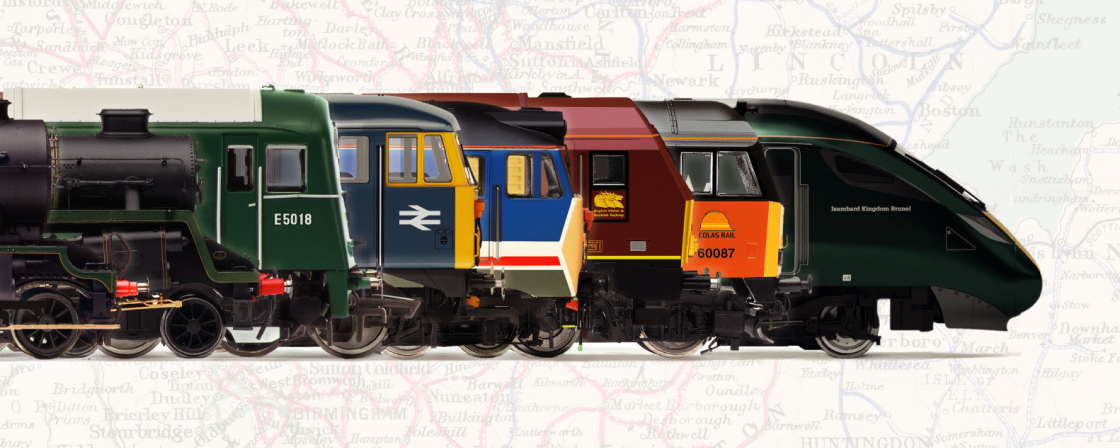
Model railway eras
You may have noticed that many of our models have an era number in their title. If you’re wondering what that means, read on!
The birth of model railway eras
The model railway industry created the era system to highlight the changes on the railways over the years. This allowed us to group models according to an era, making it easier for you to decide which models run best together.
This worked for a while, but as our model ranges expanded and evolved, the era boundaries no longer worked as efficiently. So, we created our own era system that takes these new products and modern technologies into account, as well as any “grey” areas that didn’t quite fit before.
So now you can shop by model railway era with confidence.
| ERA | DESCRIPTION | DATE RANGE | EXAMPLE |
|---|---|---|---|
| 1 | PIONEERING | 1804 - 1869 | Stephenson's 'Rocket' |
| 2 | PRE-GROUPING | 1870 - 1922 |
Peckett W4
|
| 3 | GROUPING | 1923 - 1947 | Wainwright H Class |
| 4 | EARLY BRITISH RAILWAYS | 1948 - 1956 | Gresley B17 |
| 5 | LATE BRITISH RAILWAYS | 1956 - 1968 | Standard 4MT |
| 6 | BRITISH RAIL PRE-TOPS | 1957 - 1971 | Class 71 |
| 7 | BRITISH RAIL TOPS | 1971 - 1986 | Class 87 |
| 8 | BR SECTORISATION | 1982 - 1997 | Class 50 |
| 9 | PRIVATISATION | 1996 - 2008 | Class 67 |
| 10 | NETWORK FRANCHISING | 2006 - 2017 | Class 60 |
| 11 | PRESENT DAY | 2014 on | Hitachi IEP |

Era 1 (Pioneering) 1804-1869
Era 1 covers the first locomotive-hauled railway journey to the rapid expansion and railway mania of mid-Victorian times. This is where railway innovation began, with icons such as Locomotion No.1 and Stephenson’s Rocket.
Era 2 (Pre-grouping) 1870 – 1922
As the railways expanded and passenger numbers grew, the number of operating companies spiralled and there was over 20,000 miles of track in the UK. Unfortunately, profits did not match the growth, and it was time for regulation.
Era 3 (Grouping) 1923 – 1947
Welcome in the era of the Big Four. Around 120 operating companies were amalgamated into four main ones: GWR, LMS, LNER and SR. There were also a few ‘joint railway companies’, but these four ran most of the the UK’s lines.
Era 4 (Early British Railways) 1948 – 1956
The Transport Act came into force in 1947, leading to the whole railway network being nationalised under the British Transport Council. This large-scale regeneration is recognised by the lion and wheel logo of British Railways.
Era 5 (Late British Railways) 1957 – 1968
With the railways still in public ownership, this era covers the last few years of steam operation and the invent of diesel haulage on Britain’s railways. This era is characterised by British Railway’s rampant lion and wheel logo.
Era 6 (British Rail Pre-TOPS) 1957 – 1971
A big era for railway modernisation, there was a rush of new diesel and electric rolling stock on the tracks. Many different designs of locomotive operated across the network, with varied results.
Era 7 (British Rail TOPS) 1971 – 1986
The British Rail TOPS system (total operational planning system) helped to keep track of all the different machines in use on the railway. After a period of falling passenger levels and investment, the InterCity high-speed trains were a welcome innovation.
Era 8 (BR Sectorisation) 1982 – 1997
The BR blue livery was phased out in this era, with the relaunch of InterCity and the introduction of Network SouthEast and Regional Railways. Freight operations separated into companies like Trainload Freight and Railfreight Distribution.
Era 9 (Privatisation) 1996 – 2008
Privatisation took three years to complete, starting in 1994. Passenger services were split into 25 train operating units under the rolling stock companies Eversholt Rail Group, Angel Trains and Porterbrook.
Era 10 (Network Franchising) 2006 – 2017
With the introduction of the Railway Act came the idea of passenger rail franchising to train operating companies (TOC). Network Franchising officially began in 2006, with TOCs competing for tenders.
Era 11 (Present Day) 2014 – Now
From 2014, the railway was run on a mixture of franchises and direct operation from companies like ScotRail, LNER, GWR and Avanti West Coast. Franchises were suspended in 2020, and the railway is currently under government control.
What era would you most like to model? Once you’ve decided, shop by our model railway era system here.