We recently received an exciting delivery to Hornby HQ: decoration samples for our TT:120 Class 37’s. We couldn’t wait to give you an update on these amazing models.
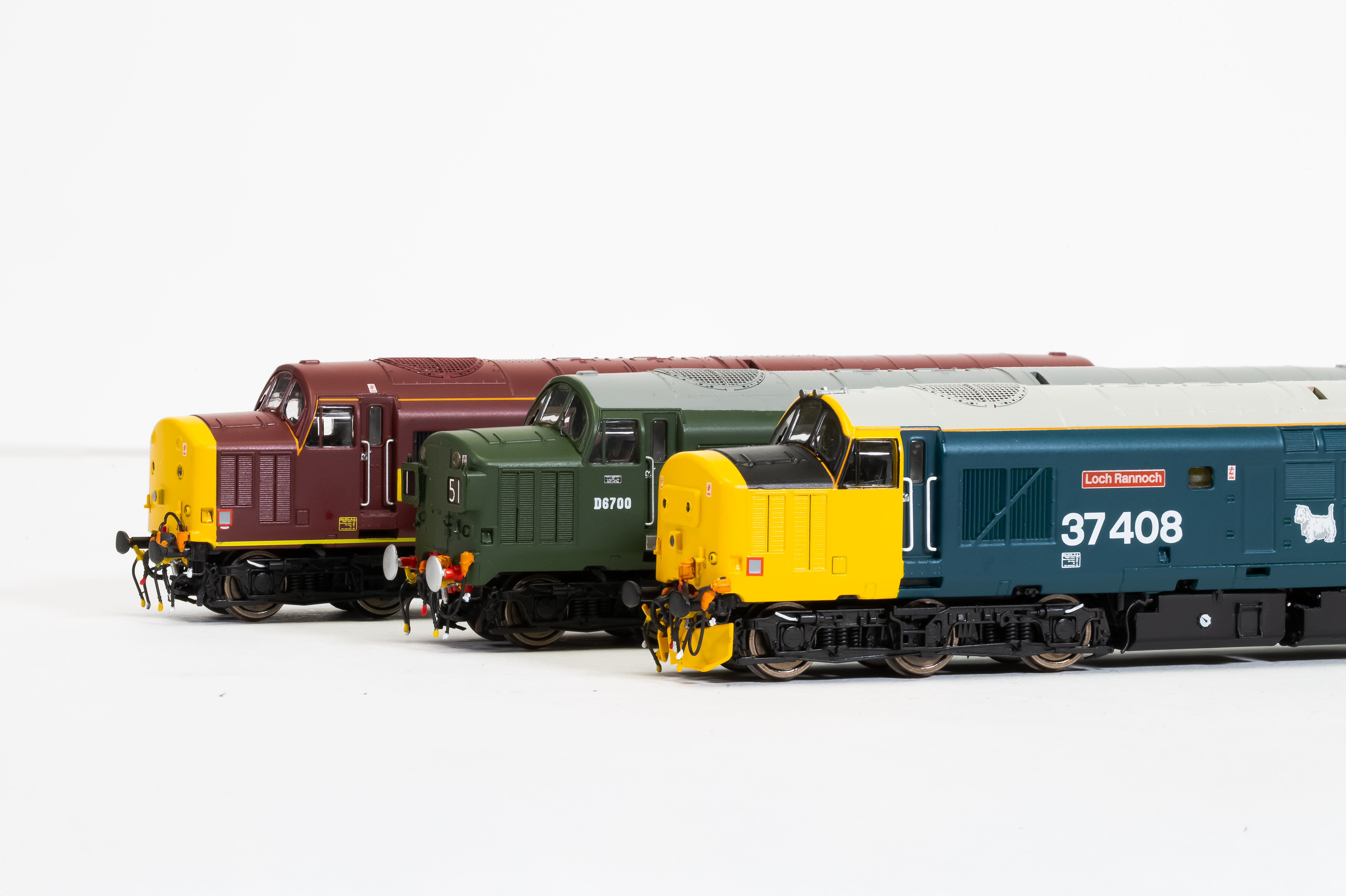
Decoration sample subject to change
Initially known as English Electric Type 3s, 309 of these locomotives were built between 1960 and 1965. They were given the designation Class 37 under the TOPS classification system rolled out by British Railways in 1973.
These locomotives had two bogies, each with six powered wheels, referred to as Co-Co, and a power output of 1,750hp (1,305kW) from their turbocharged V12 diesel engines.
They were designed for freight work, but also for passenger duties on secondary routes. Many of the class were fitted with steam-heat boilers to warm the passenger coaches. They had relatively low gearing, which was ideal for moving heavy freight trains, yet they were also capable of speeds of 90mph (140km/h) which was equally useful on passenger trains.
The class 37s were extremely versatile machines and saw service across the whole of the UK, apart from on the Southern Region south of London. In the 1980s, they were selected as standard Type 3s and many were given overhauls to extend their working lives into the 1990s.
Fitted with Electric Train Heating (ETH), several examples went to Scotland to work passenger services on the West Highland Line and also the Far North Line, while others were deployed on Welsh Marches trains, the Wherry Line in Norfolk, South Wales, the West Country and the Cumbrian Coast line.
Some were given replacement Mirrlees or Ruston engines for a proposed Class 38, but in the event were given the sub-classification 37/9. The locomotives’ relatively low axle loading for their weight and power left it as the only main line type available in significant numbers for lines with weight restrictions.
Many are still in use to this day, used mainly on freight, maintenance/engineering trains and empty stock movement, with a growing number finding their way onto charter work with operators such as West Coast Railways. As of 2024, 65 examples were still registered for main line work, plus there are more than 30 that have been preserved in the UK
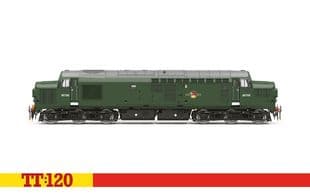
D6700 was the first member of the English Electric Type 3s (later Class 37) to be built and, as such, was secured for preservation upon its retirement. It is now part of the National Collection but is currently on loan at the Great Central Railway, where it is in operational condition.
It emerged from Vulcan Foundry at Newton-le-Willows in December 1960 with split-headcode panels, and was initially allocated to Stratford depot in East London. Its BR career took it to Haymarket (Edinburgh), March, Thornaby and Gateshead. Originally in all-over BR green, it was repainted into BR blue and yellow ends in June 1969 and received its TOPS number 37119 in February 1974.
In March 1988, it was reclassified to sub-class 37/3 and among the changes made, its fuel capacity was increased, utilising the space from the redundant steam-heat boiler. It also became No. 37350. After almost 39 years, and seeing out its later career back ‘home’ at Stratford depot, it was withdrawn in December 1999.
The model is presented in the livery it entered service in 1960, in all-over green (no yellow warning panels) and the BR ‘ferret and dartboard’ logo, the condition to which it has been restored in preservation.
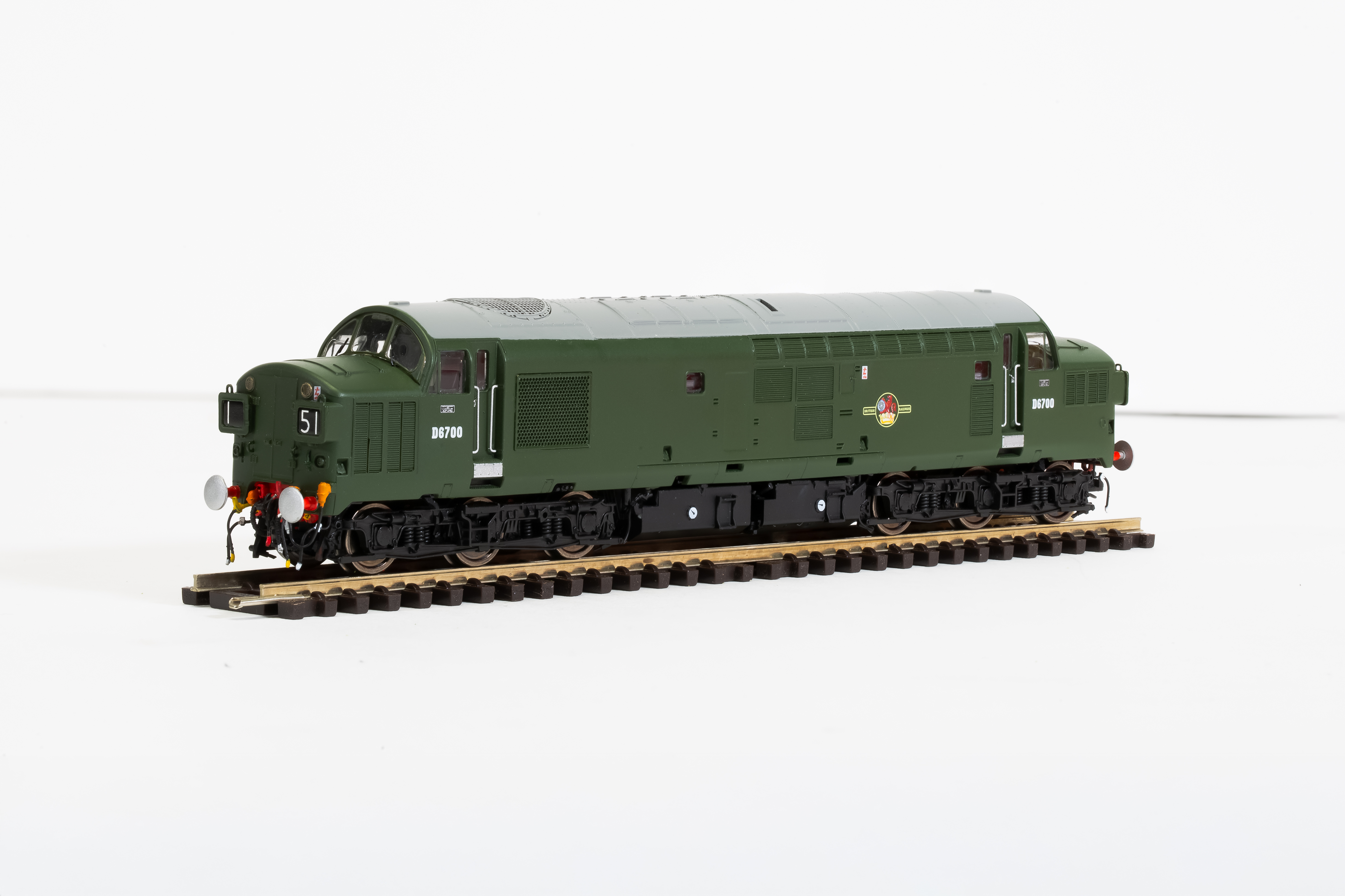
Decoration sample subject to change
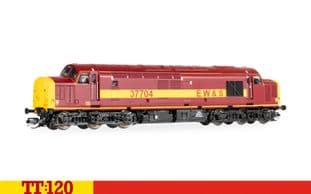
Released from Vulcan Foundry in March 1962, this locomotive went new to Hull Dairycoates depot as D6734. Under the BR TOPS reclassification scheme, it became Class 37 No. 37034 in March 1974. As built, the locomotive had split-headcode boxes, which allowed for an end gangway door between them, but these were later removed.
In January 1986, it became part of a dedicated heavy freight fleet of 44 locomotives which were given the sub classification 37/7 and received the new number, 37704.
These locomotives were given extra ballast weight and were particularly common on heavy South Wales steel and coal trains. They also worked 32-wagon ‘merry-go-round’ trains of 32-tonne air-braked ‘HAA’ hopper wagons. After 1996, No. 37704 became part of the EWS fleet and received its distinctive maroon and yellow livery.
By the time the locomotive was withdrawn in October 2003, it had completed an incredible 41 years and six months of service. It was scrapped at T.J. Thomson & Sons Ltd’s yard in Stockton by June 2009.
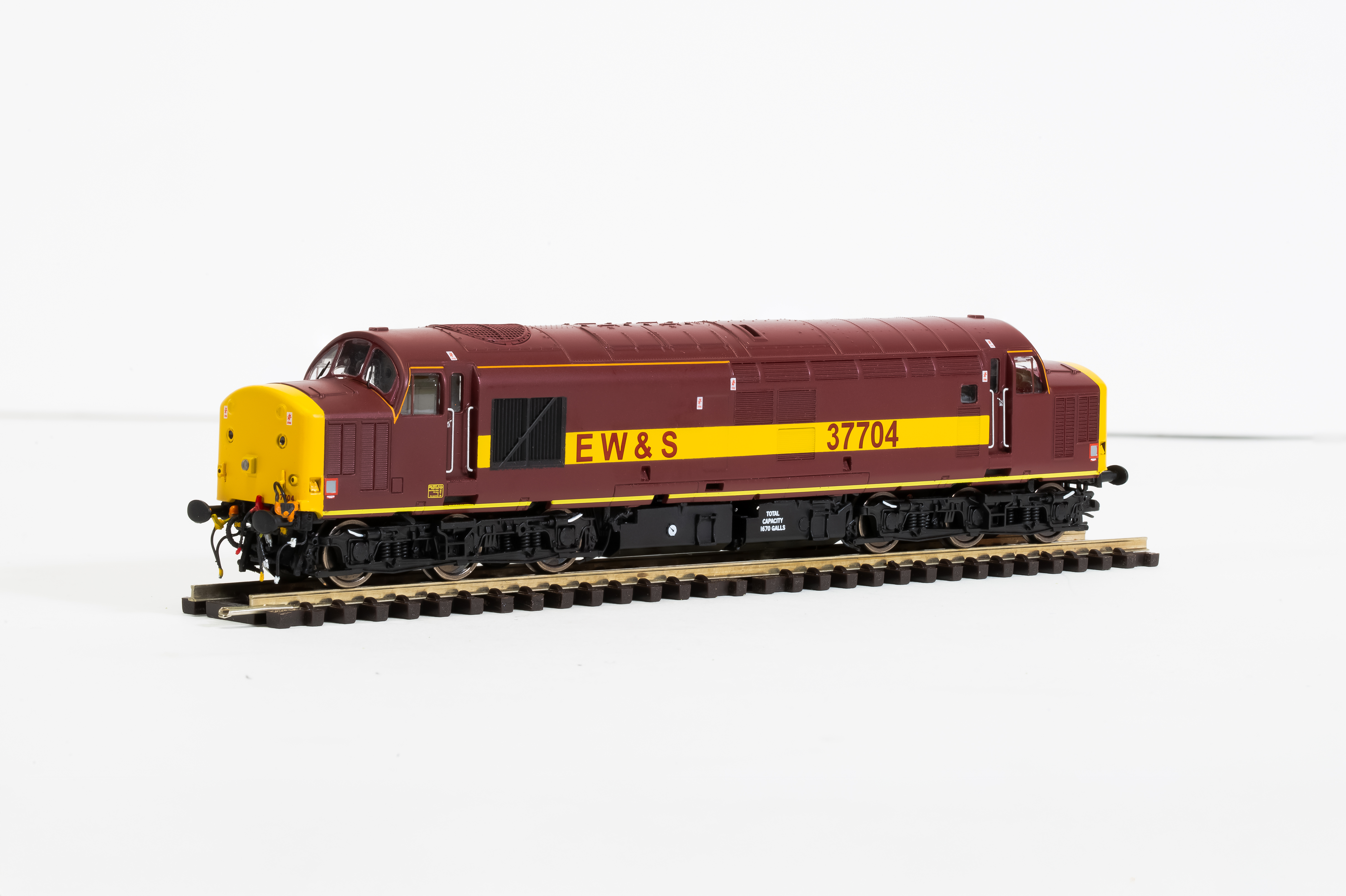
Decoration sample subject to change
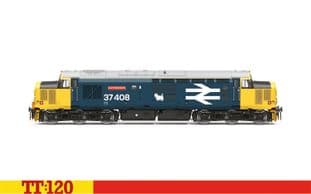
Built at English Electric’s Vulcan Works in 1965, this locomotive entered traffic as D6989 on 17th June and was initially allocated to Cardiff Canton depot. It was renumbered to 37289 under BR’s TOPS system in 1974. In August 1985, the locomotive was fitted with ETH, renumbered to 37408 and repainted in BR ‘large logo’ blue livery as one of 25 that went north to work passenger trains in Scotland.
It was named ‘Loch Rannoch’ at Eastfield depot, Glasgow, in September 1986 and adorned with the depot’s white Scottie Dog motif. It is in this livery that the model is presented. By November 1989 it had transferred to Immingham and the Departmental Civil Engineers’ pool.
This was followed by spells in the Trainload Petroleum sector and Trainload Freight West before becoming part of the EWS fleet in 1997. The locomotive was extensively damaged when it ran into parked stock at Rhymney in August 2005 and went into store for component recovery. It was subsequently scrapped at EMR Kingsbury in January 2008.
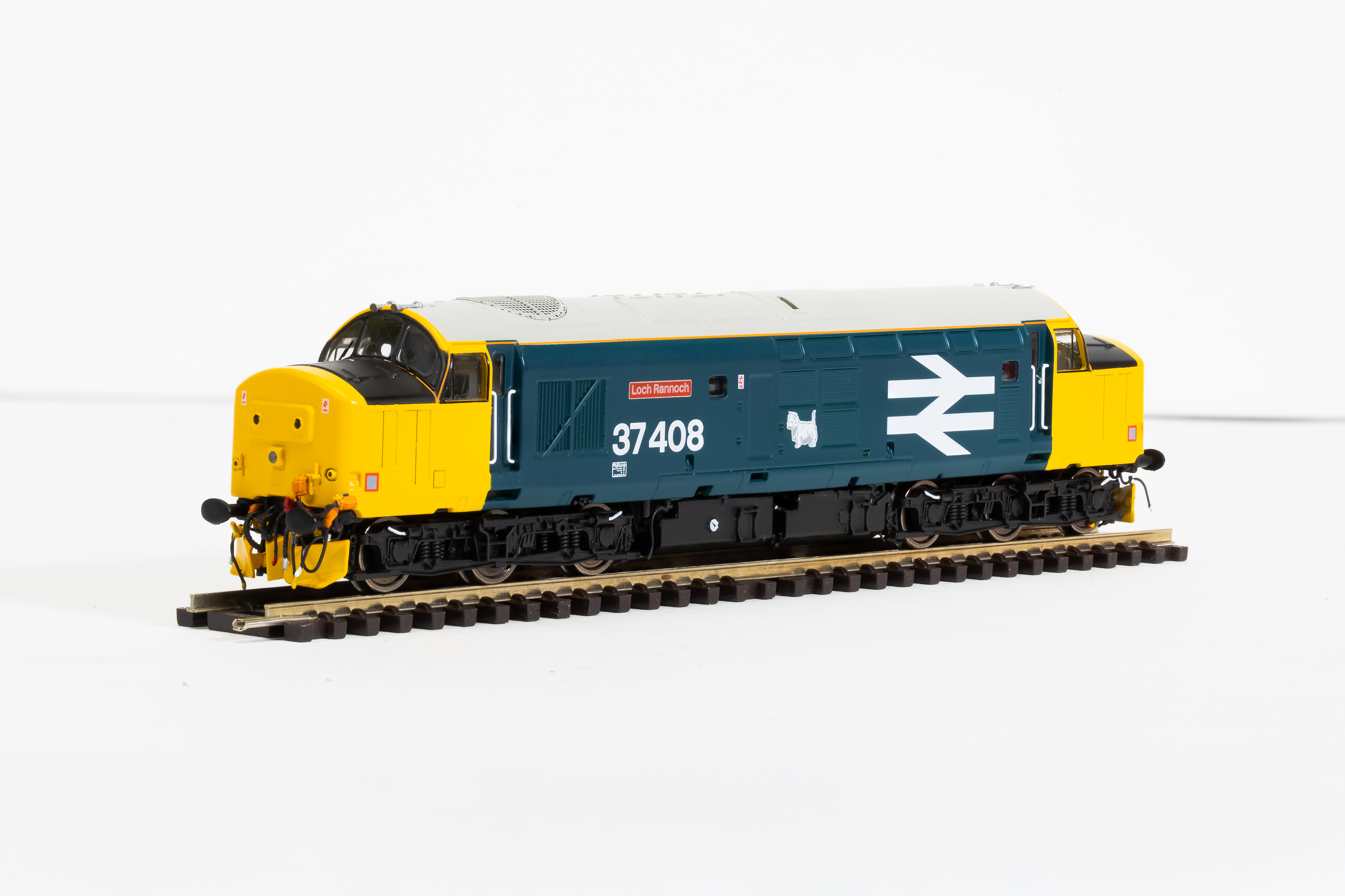
Decoration sample subject to change
We spoke to designer Sam about the development process for these fantastic models.
What stage are you at with the development?
The newly tooled Hornby TT Class 37 is currently at the late decoration stage. The design began in September 2023 and took around eight months to get into tooling. First shot mouldings were received in early October 2024 and the first running sample shortly after. Although the development was well under way, the specific products were only announced in January 2025.
Are you happy with the model at this stage? What are the next steps?
After fixing some minor issues with the decoration and lighting, the Class 37’s are well on their way to approval. Currently, the instructions are being finalised before the final samples will be sent to Margate for approval.
Have there been any difficulties in the development process?
The Class 37’s were built between 1960 and1965, with 309 of the class entering service. Since then, they have been a main stay on British rails with many making it to preservation and others still thrashing up and down the country.
Over the years, the 37’s were extensively upgraded with seven sub-classes numbers. As such, there were many variations to account for, especially as individual units can be modified and upgraded on a case-by-case basis as required. Keeping track of all of these changes was a challenge but allows us to produce unique TT Class 37’s for years to come.
What are the key features of these model?
Like our previous diesel locomotives in TT before it, the Class 37 features a powerful five-pole motor, weighted die-cast chassis and fine-toothed gearing to provide superb running at slow and fast speeds.
The extensive tooling suite covers a range of variations, with features including split headcodes, central headcode, horns, headlights, marker lights and front grill configurations. The Class 37 can be fitted with a Next18- HM7000 decoder for sound and advanced lighting control on DCC or the HM|DCC app, with dedicated space inside the loco to fit the HM7070 Power Bank.
Why should modellers pick up these models?
The three Class 37’s in this first release cover three diverse eras of the locomotive’s lifetime, from the early service under BR to modern working with EWS. The 37’s were used up and down the UK (except in the Southern Region below London), so there is plenty of modelling potential spanning multiple years of both freight and passenger work.
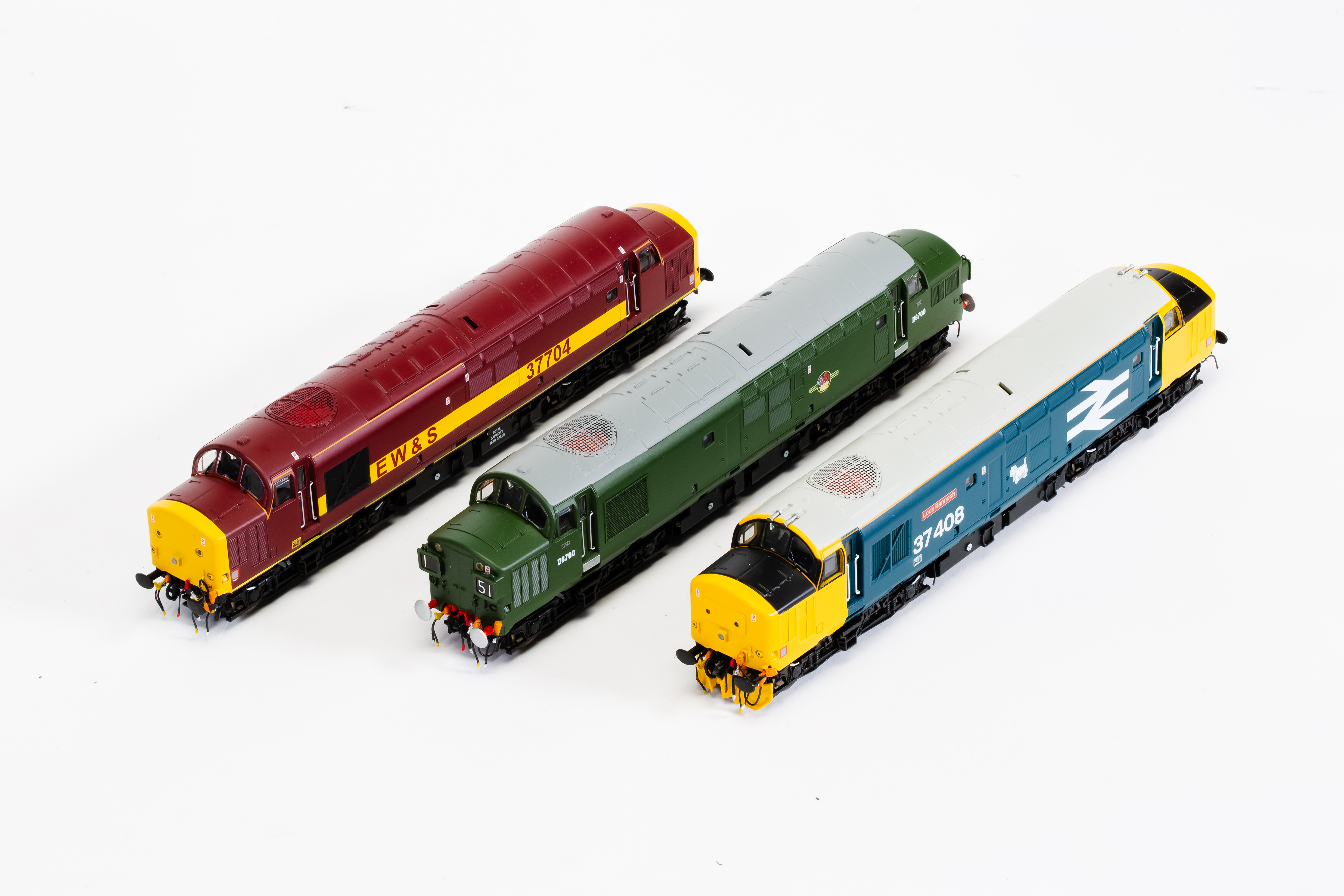
Decoration sample subject to change
Thanks to Sam for the update on the design process.
We are delighted with how these models are looking so far, with minor improvements to be made to the decoration and the lighting functionality. We will also be tweaking the fitted parts, including the distance between the handrails. These models run perfectly, and the sound profile has been fully developed and tested.
All three of these models are available DCC-ready with a Next 18 Pin Socket or, for added realism, we have DCC-fitted versions enabling you to use our HM7000 system with your model.
What Class 37 livery is your favourite? Let us know in the comments below!
Don’t miss out on adding these amazing models to your TT:120 line-up by pre-ordering yours now.