
Publication Date: 26th April 2023
Welcome to the April edition of Train Terminal. In this month’s edition, we will focus on the development of the Class 43 HST locomotives together with the Mark 3 coaches and how Hornby helped a local model railway group in East Kent with their TT:120 track layout.
The BR Class 43 HST diesel unit has been an iconic sight travelling on British railways for 40 years. Also known as the ‘Intercity 125’ under BR, this high-speed locomotive could travel speeds of up to 148mph. This class currently holds the record of the fastest diesel passenger train with HST achieving 144mph on the East Coast Main Line, between Newcastle and London King’s Cross, on September 27, 1985.
Photo by Hugh Llewelyn 43 089 | BR Class "43/0" HST 2,250 hp Bo-Bo No.43 089 (later… | Flickr
Each Class 43 is adept at high-speed travel due to being powered by a Paxman Valenta prime mover. The prime mover operates at 1500rpm and can produce 2,250 horsepower. The designer, Kenneth Grange, made sure the HSTs were aerodynamic and lightweight with the low axle load contributing to quick acceleration and reduced wear on the railway lines. At nearly 50 years old, the HSTs are still in use and are either being retrofitted or replaced.
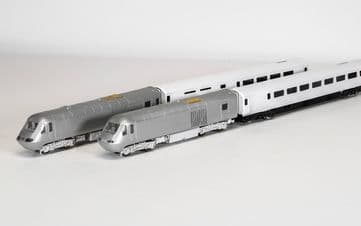
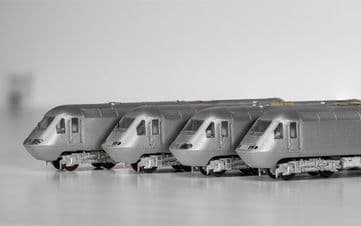
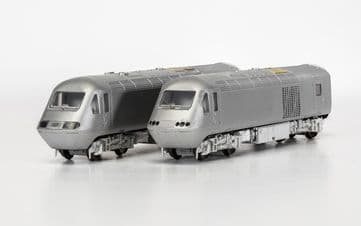
Learning from the recent tooling update of the '00' model, the Hornby TT:120 versions will have full lighting with independent control and ideal use with the HM7000 18 pin decoder. Headlights and cab lighting are already moulded for them and are featured together with a sugarcube speaker to use sound.
Building with detail, the tooling caters for all exhaust types. There will be a version with no exhaust. A long and short cover for the exhausts will be provided on different versions.
Three types of fans will be incorporated inside specific bodies and features a radiator, a double fan and a single fan.
Mark 3 coaches are still prominent on British rails and entered service in 1976 with the MK3Bs being paired with the Class 43 HSTs. The consist of the train is usually made up of a rake of up to nine Mark 3B coaches.
The Mark 3B coaches will also feature new tooling and different variations, as detailed below. Door release catch and door lights will be included.
For the restaurant cars, there are two versions, TRUB and TRFB.
The kitchen car, or TRUK, interior includes a kitchen space with the seating area in line with the windows.
Finally, the TGS variant features the guard compartment at the rear of the coach as illustrated.
Both the Class 43 HST locomotives and the Mark 3B coaches will be produced in different variations which reflects the actual prototypes. Please check back for future editions for further updates on the development of these models.
This month, The Man Shed in Birchington, Kent, in collaboration with the East Kent Model Railway Society, were in the process of building a TT:120 track to exhibit at the Birchington Model Railway Exhibition. Near completion, the team ran into a problem. They only had one locomotive and a few carriages for the layout.
Hornby heard about the group’s dilemma and loaned several locomotives and carriages from the new Hornby TT:120 range. Simon Kohler, Marketing & Development Director, and Jade Fowler, Marketing Assistant, visited the Man Shed at Quex Park to hand over the Hornby TT:120 scale models.
Hornby attended the Birchington Model Railway Exhibition on Saturday 15th April and saw the completed TT:120 track complete with rolling stock from the Hornby TT:120 range.

