
Welcome to the third Train Terminal blog. In this edition, we go behind the scenes of the Hornby TT:120 development process and show you how these models were created.
The CDA Hopper is a derivative of the ubiquitous HAA Hopper, part of the MGR or Merry Go Round train concept pioneered by BR in the mid 1960s. HAA Hoppers, the mainstay of the MGR concept, totalled over 11,000 at the peak of their usage, with MGR services being a common sight on the mainline between the later 1960s and 1980s.
The image below (property of the BR Board) shows how a typical MGR train would appear when hauled by a Class 26 in the BR green livery. Early MGR trains such as the below, also utilised brake vans, this was something that was discontinued (on all services other than those that included dangerous chemicals) around the time the services began to decline in the latter half of the 1980s.
The MGR service streamlined deliveries to power stations, as the wagons would not need to stop to be unloaded. Instead of stopping, the wagons dropped their cargo whilst on the move, albeit at a slow speed, via doors on the bottom of each Hopper. To this end, several classes of locomotives were equipped with a slow speed mode, including some that were never used on MGR services such as the Class 50. In the below image (also from the BR Board), an MGR train can be seen in its unloading dock.
Some of the larger power stations of the UK required millions of tonnes of coal each year, this was a role best served by the MGR with a single Hopper able to replace almost 20 pre-existing mineral wagons. The HAA Hoppers saw many modifications over their lifespan to improve certain aspects of the design. One such variation is the HBA, as can be seen in the Railfreight factsheet from the Rovex Archive. Perhaps the more subtle of the modifications, this version included a canopy to allow the wagons to run at a higher speed than the original HAA Hoppers.
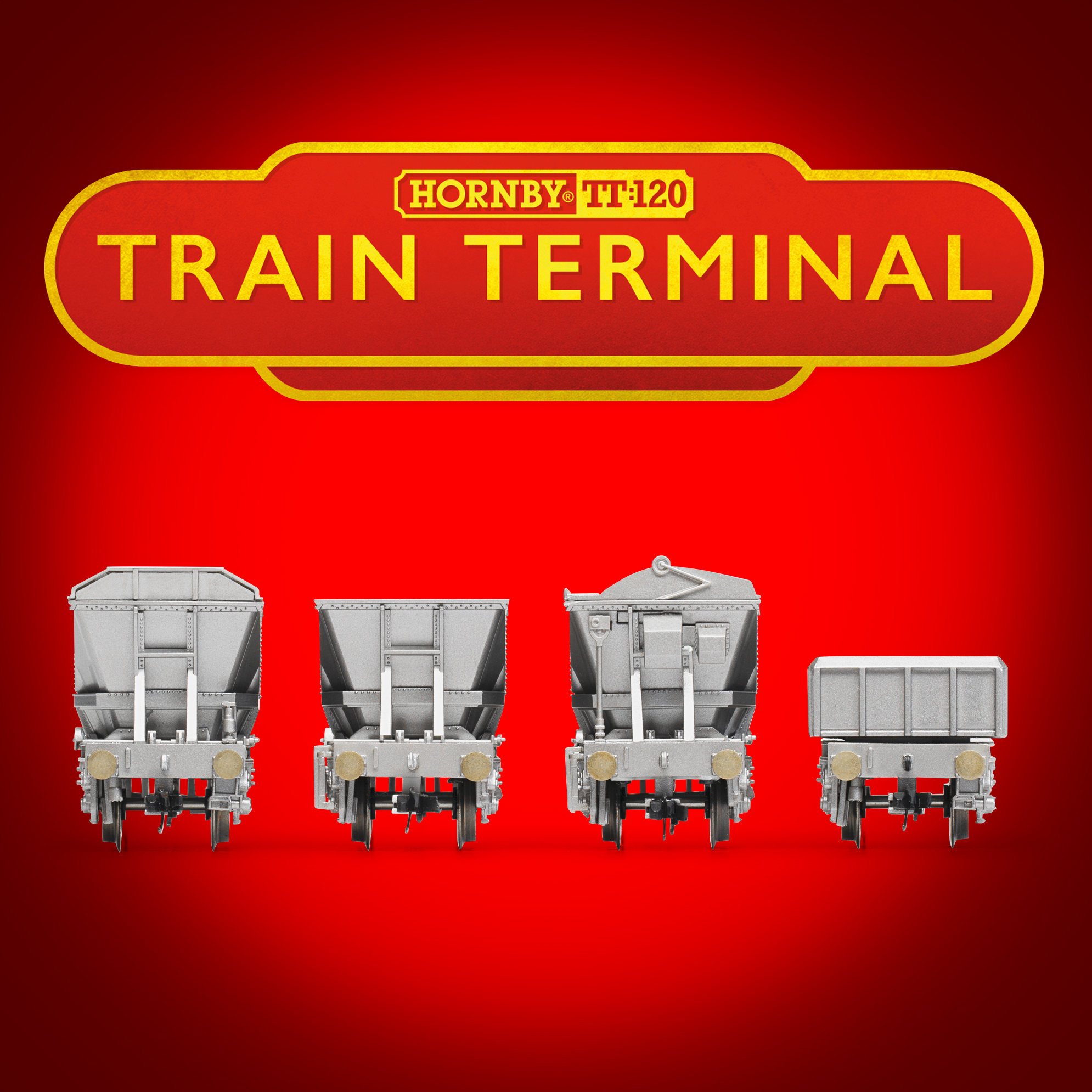
A huge amount of research was conducted for the 1980 and 2003 Hornby ‘00’ released variants of these MGR type Hopper Wagons, this has allowed for the ‘TT’ models to be designed without too much difficulty, samples of which can be seen below.
These four wagons represent the start of the Hornby TT:120 Era 7-10 rolling stock range, there are many more planned including a KFA container wagon and YGB Seacow. The wagons above will most certainly be suitable rolling stock for the soon to be released Class 08 shunters, as well as future mainline traction such as the Class 37, 47, 50 and 66.
From an end-on angle, one can appreciate the size and detail difference between each of the wagons. The above wagons, in order of left to right, are an HFA, HAA, CDA and MHA.
Whilst not being a part of the MGR train system, the MHA Ballast Wagon utilised the same underframe as the MGR, and as such it was thought prudent to produce this wagon at the same time as the MGRs.
The above image shows quite clearly the underside detail. The diecast doors fitted represent those that would spring open to release the cargo as it passed over the coal chute at the Power Station. It is worth noting that this underside is not shared by the MHA which would have these doors removed from the chassis, hence it has been omitted from the model. Also in the above image, the sprung kinomatic NEM pockets can be seen with close couplings fitted.
Following on from that brief look into the development process, we are thrilled that the first shipment of the Hornby TT:120 ‘The Scotsman’ train set has been despatched with a second shipment scheduled for delivery in January. This will then be followed by ‘The Easterner’ which is also expected in January ’23.
The delightful LNER Apple Green liveried Class A1, ‘Blink Bonny’ locomotive is paired with the equally elegant Pullman Cars that make up ‘The Scotsman’ set. Initial feedback from those who have taken delivery of the sets has been extremely favourable, such as, ‘Beautifully detailed’, ‘excellent decoration’, ‘runs superbly’, plus numerous other positive comments.

