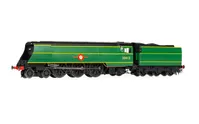
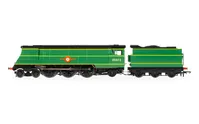
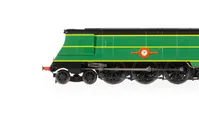
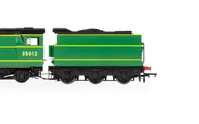
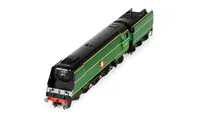
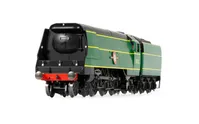
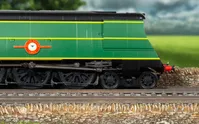
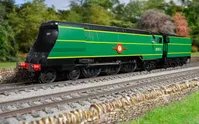
R3860 BR, Merchant Navy Class, 4-6-2, 35012 'United States Lines' - Era 4
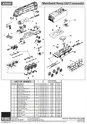
Product Info
Conceived in 1937 when Oliver Bulleid became Chief Mechanical Engineer of the Southern Railway, the Merchant Navy Class represented Bulleid's vision for a quick accelerating, mixed traffic 4-6-2 locomotive, equally capable of hauling passenger services (such as the Golden Arrow and Atlantic Coast Expresses), or freight workings, to a speed of around 75mph.
Mainly designed from the Brighton Works Drawing Office, under C.S Cocks, Bulleid, always aware of the practical applications and costing implications ensured that the best design practices of the time were applied to the new locomotive. Like his mentor, Nigel Gresley, Bulleid was a technically arrogant CME, an advocate for locomotives being driven hard and to brisk schedules and this materialised in his design ideas.
In 1934, Bullied had been opposed to the use of streamlining but for the Merchant Navy's 'air-smoothed' design is suited his purposes, being easy to clean mechanically and hiding the boiler's external pipes, which in turn meant that they could be run for function, rather than aesthetics. Opting for a welded steel firebox, instead of traditional copper construction for reduced weight and pressure benefits, Bulleid was able to make the three equally sized cylinders smaller, at 18', and better balanced.
New X-ray inspection techniques were specifically developed to monitor wear to the welded areas, whilst the newly designed Bulleid Firth Brown 6" 2' driving wheels reduced the amount of hammer blow to the rails, also resulting in less wear. Of all the new features Bulleid incorporated into the design, perhaps the most ingenious and, ultimately, most controversial was his decision to totally enclose the valve motion in an oil bath to prevent attritional wear through grit ingress.
Despite the onset of war in 1939, Bullied's design was accepted by the wartime Railway Executive Committee and production commenced though November 1940 at Eastleigh Works. The first member of the class, Channel Packet, was introduced in June of 1941 as the rather complicatedly numbered 21C1. Only 20 locomotives would be built under the SR, with a further 10 being built by BR entering straight into their service between 1948 and 1949. The last of the locomotives would be withdrawn towards the end of steam on BR in July of 1967.
Locomotive 35012 entered service with the Southern Railway in January 1945 with the palindromic locomotive 'number' 21C12. It would gain its more conventional number under BR before being rebuilt by the nationalised operator in February 1957, making it one of the first examples to be rebuilt. The locomotive would go on to serve under BR, mainly on the former Southern region before being withdrawn in April 1967. United States Lines would be scrapped in Newport shortly after.
The Hornby Merchant Navy is fitted with a powerful five pole motor and a large flywheel providing excellent performance. The locomotive if fitted with a fully detailed cab, tender pickups, NEM pockets front and rear and a 8 pin decoder socket.



Welcome to the HM7000 Control System
HM7000 is an innovative way of controlling and operating model railways. Combining Bluetooth® technology and app-based control, the HM7000 Control System has been designed to revolutionise the controlling of a model railway.
Learn more
- Bluetooth® Connectivity
- Free Sounds
- Quick CV Editing
- Multiple Control Options
- 40+ Profile Settings
- Other Options
Upgrade Paths
Previous Control Systems can be upgraded to HM7000, see below for the options and upgrade paths available.
-
Train Set > HM7000
Already have a locomotive but want to go digital? Click here to discover how.
-
HM6000 > HM7000
The HM6000 system is only a short step away from having HM7000. Click here to discover how.
-
HM|DC > HM7000
New to the hobby? HM7000 is just a short step away. Click here to discover how.
-
DCC > HM7000
Already operating a layout using DCC? HM7000 is just a short step away. Click here to discover how.
-
Conventional DCC Controller > HM7000
Locomotives fitted with either a Hornby HM7000 or conventional decoders can be operated using the HM|DCC Bluetooth® system - click here to learn how.
HM7000 Products
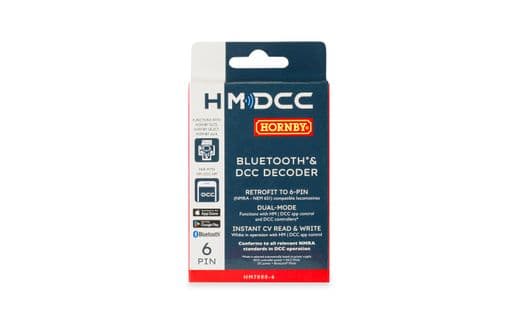
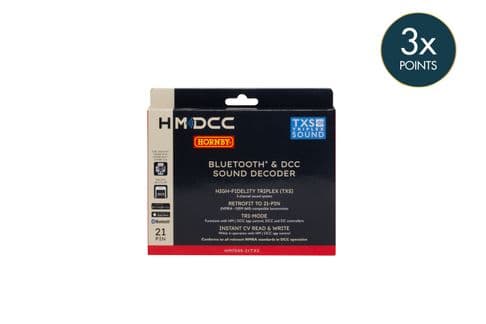
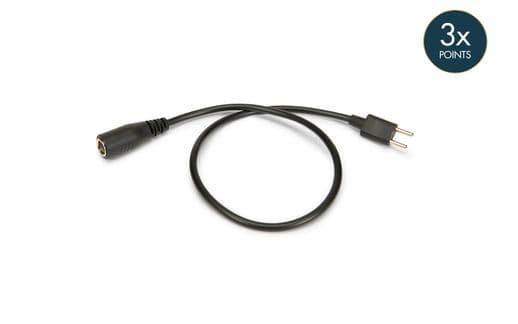
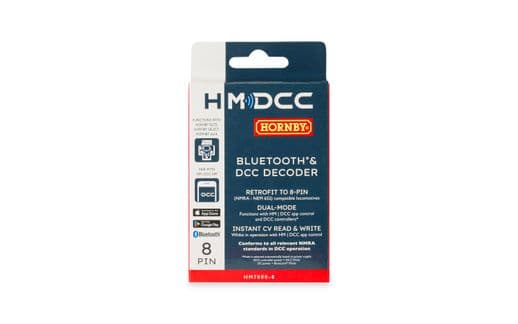
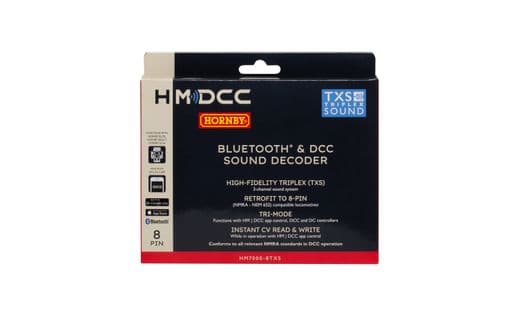
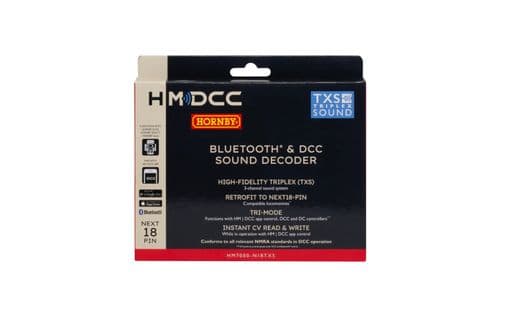
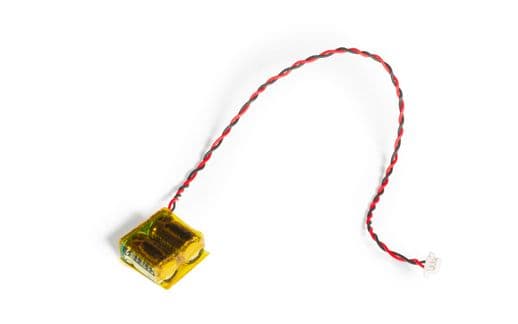
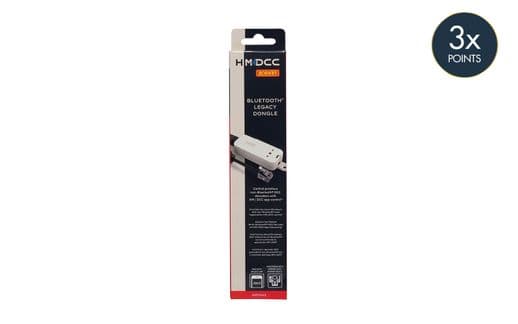
The following points must be considered below when purchasing. HM | DCC and the HM7000 decoders have been extensively tested up to a range of 45 metres in plastic bodied locomotives and up to 12 metres in die-cast bodied locomotives. HM | DCC and the HM7000 decoders have been extensively tested up to a max of 14 non-stationary, running locomotives. HM | DCC and the HM7000 decoders have been extensively tested on iOS devices dating as far back as 5 years from today's date. Any devices older than this cannot be commented on for proper function by Hornby Hobbies. Please ensure that the incompatibility list is considered prior to any purchase.
What's Inside
Recommended For You
Tech Specs
- Item Length - Without Packaging (cm)
- 29.1
- Item Height - Without Packaging (cm)
- 5
- Item Width - Without Packaging (cm)
- 3.5
- Item Weight - Without Packaging (kg)
- 0.44
- Item Scale
- 1:76 Scale 00 Gauge
- DCC Status
- DCC Ready 8 pin socket
- Operator
- British Railway
- Designer
- Oliver Bulleid
- Wheel Configuration
- 4-6-2
- Minimum Curve (mm)
- Radius 2
- Number of Parts
- 1
- Class
- Merchant Navy Class
- Buffer Type
- Sprung Metal Buffers
- Coupling Type
- NEM Tension Lock
- Hornby Decoder Compatibility Primary
- HM7000-8TXS: Bluetooth® & DCC Sound Decoder (8-pin)

Detailed scale model. Not suitable for children under 14 years. Please refer to safety notes in enclosed instruction leaflet. Colours and contents may differ from those illustrated. Please retain these details and the address for future reference.